

Derma V Vascular and Pigment Laser
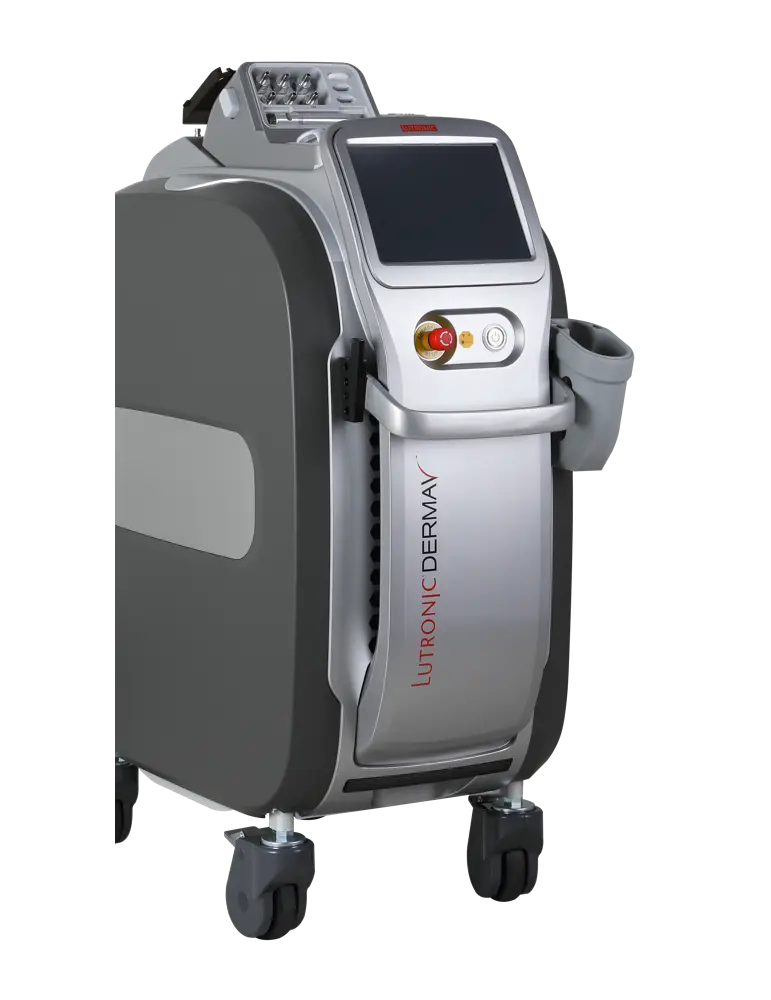
What is Derma V?
Derma V is a vascular and pigment laser from Lutronic, now part of Cynosure Lutronic. It carries two wavelengths in one platform: a 532 nm green laser that is strongly absorbed by both haemoglobin and melanin, and a 1064 nm laser that reaches deeper vessels and is gentler on pigment. That pairing lets it tackle reds and browns from the same console.
Dr Garara uses it mainly for facial redness, rosacea, broken capillaries and brown sun damage. Built-in cooling protects the surface and keeps the treatment comfortable, and the device is designed to clear vessels without the bruising that older vascular lasers often left behind.
The treatment relies on selective photothermolysis: 532 nm is absorbed by haemoglobin and melanin for surface targets, while 1064 nm reaches deeper and is gentler on pigment, which makes it the safer choice in darker skin.
At a glance
Device type
Long-pulsed 532 nm KTP and 1064 nm Nd:YAG laser
Manufacturer
Lutronic (Cynosure Lutronic)
How it works
Light is absorbed by haemoglobin and melanin to clear vessels and pigment
Signature tech
Integrated cryogen cooling, Variable Sequential Pulsing, temperature sensing
Best known for
Facial redness, rosacea, thread veins and brown pigmentation
Also treats
Skin rejuvenation; 1064 nm for deeper vessels and hair reduction
Typical course
Often a short series; some lesions clear in one session
Downtime
Usually mild redness; the device aims to avoid bruising
Skin types
Adjustable across skin types; wavelength chosen to suit the tone
How it works
532 nm (green): strongly absorbed by haemoglobin in small vessels and by melanin in surface pigment — the workhorse for facial redness, thread veins and brown spots.
1064 nm (Nd:YAG): penetrates deeper to treat larger or deeper vessels, and because melanin absorbs it less it is the safer choice in darker skin and for hair reduction.
Cooling and pulsing: integrated cryogen cooling protects the epidermis, while Variable Sequential Pulsing tailors the pulse to vessel size for cleaner results with less swelling.
Tracking and sensing: IntelliTrak and real-time temperature feedback help deliver even coverage and stay within safe limits.
The benefits
Clears facial redness and rosacea by targeting the dilated vessels behind persistent redness and flushing.
Treats thread veins and capillaries on the face and elsewhere.
Fades brown pigmentation — the 532 nm wavelength lifts sun spots and uneven tone.
Two wavelengths, more options: adding 1064 nm reaches deeper vessels and widens who can be treated safely.
Comfortable and low-bruising, thanks to cooling and tailored pulsing.
Supports rejuvenation by treating redness and pigment together for a clearer, more even look.
Concerns it treats
What to expect
Before
Consultation and assessment of the vessels or pigment being treated.
During
The handpiece passes over the area with cooling at the tip. People feel a warm snap. Sessions usually run a few minutes to about half an hour.
Immediately after
Redness and slight swelling; vessels may darken or fade on the spot.
Downtime
Usually mild and short; the device aims to avoid bruising.
Results
Vessels and pigment clear over days to weeks; some need more than one session.
Course
Some lesions settle in a single session; redness and diffuse pigment often need a short series.
What the evidence shows
Rosacea and facial redness
- A clinical study of the 532 nm dual-wavelength laser for rosacea reported effective clearance of facial redness with no purpura (bruising) and good comfort, helped by the cooling system (Bernstein EF, Lasers Surg Med, 2023).
Vascular and pigmented lesions
- A study of the device across vascular and pigmented lesions found it safe and effective, with imaging correlation showing significant vessel reduction across skin types I to IV (Wang JV et al., Dermatol Surg, 2024).
A note on skin of colour
- The 532 nm green light is also absorbed by melanin, so on its own it is best suited to lighter skin (roughly Fitzpatrick I to IV). For richer skin tones the 1064 nm wavelength is generally the safer route because melanin absorbs it far less, and integrated cooling adds protection. Darker skin is assessed carefully, settings matched to tone, and a test response is sensible before a full treatment.
Individual results vary and depend on assessment at consultation. Manufacturer figures are attributed as such.
Key facts
- Derma V is a long-pulsed 532 nm KTP and 1064 nm Nd:YAG laser by Lutronic (Cynosure Lutronic).
- It treats facial redness, rosacea, thread veins and brown pigmentation, with cooling to limit bruising.
- The 532 nm wavelength suits lighter skin; the 1064 nm wavelength is generally safer for darker tones.
- Published studies report effective rosacea clearance with no purpura and vessel reduction across skin types I to IV.
- Downtime is usually mild, with some lesions clearing in a single session.
References & sources
- Bernstein EF. A novel dual-wavelength 532/1064 nm laser effectively treats rosacea. Lasers Surg Med. 2023;55:734-740. (Manufacturer-supplied citation — verify.)
- Wang JV, et al. Safety and efficacy of a dual-wavelength laser for vascular and pigmented lesions. Dermatol Surg. 2024;50(3):277-281. (Manufacturer-supplied citation — verify.)
- Lutronic / Cynosure: Derma V device information and indications, cynosure.com.

Your skin has a story. Learn to read it.
UHai analyses your skin across multiple dimensions — tone, texture, pigmentation, hydration and more — and generates a personalised clinical report in minutes. No appointment needed.
- A clinical skin report, personalised to you
- Analyses tone, texture and pigmentation
- Free to use, no appointment needed
Explore FAQs on Derma V
Find answers to common questions about Derma V.
Mainly facial redness, rosacea, thread veins and broken capillaries, plus brown pigmentation such as sun spots. The 1064 nm wavelength also reaches deeper vessels and can be used for hair reduction.
The device is designed to clear vessels without purpura, helped by its cooling and tailored pulsing. Most people have only mild, short-lived redness.
The 532 nm wavelength is best for lighter skin, while the 1064 nm wavelength is generally safer for richer tones because melanin absorbs it less. Settings are matched to your skin and a test response is sensible.
Some individual vessels clear in one session. Diffuse redness and pigment usually respond best to a short course.
Yes. By targeting the dilated vessels behind the redness, it can reduce the background flush and visible capillaries of rosacea.
Most people describe a warm snapping sensation. Integrated cooling makes it comfortable for most without anaesthetic.
Begin with a proper assessment.
Tell us a little about what you're looking for and we'll match you with the right consultation — at the clinic or virtually.