

Dermalux LED Phototherapy
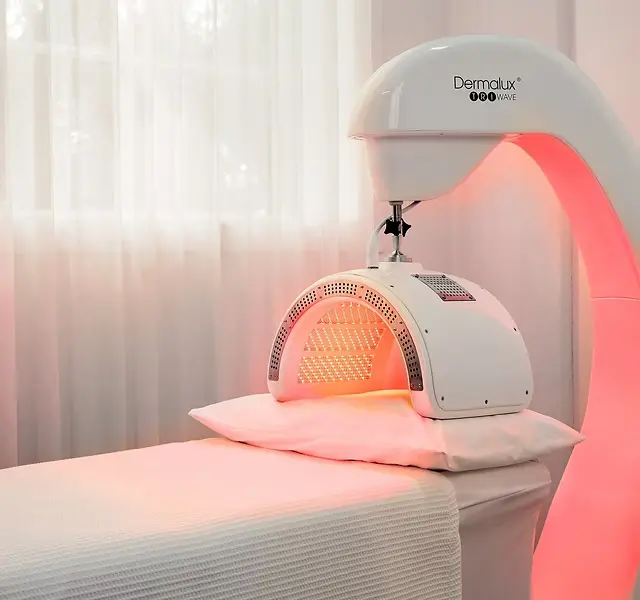
What is Dermalux Phototherapy?
Dermalux is a medical LED phototherapy system made in the UK by Aesthetic Technology Ltd. Instead of heating or wounding the skin, it bathes it in specific wavelengths of light that skin cells absorb and use as energy. The effect is gentle and cumulative, which is why it is often added to other treatments to calm the skin and speed recovery, as well as used as a treatment in its own right.
Dr Garara uses its three wavelengths for different jobs: blue light for breakout-prone skin, red light to rebuild and rejuvenate, and near-infrared to calm inflammation and support healing. There is no heat, no needles and no downtime, and it is safe across every skin tone.
The mechanism is photobiomodulation: light absorbed by the skin's cells nudges them to work more efficiently. Because the effect comes from light energy rather than heat, melanin is not a target, so the treatment is comfortable and safe for all skin tones.
At a glance
Device type
Medical LED phototherapy (non-thermal light)
Manufacturer
Aesthetic Technology Ltd, UK
Wavelengths
Blue 415 nm, Red 633 nm, Near-infrared 830 nm
How it works
Light energises skin cells without heat or injury (photobiomodulation)
Best known for
Acne, redness, healing and skin rejuvenation
Comfort
Relaxing and painless; no downtime
Typical course
Often a course of sessions; frequently paired with other treatments
Downtime
None
Skin types
Safe for all skin types
How it works
Blue 415 nm: absorbed by the bacteria involved in acne, helping to reduce breakouts and calm blemish-prone skin.
Red 633 nm: taken up by the energy centres of skin cells, prompting fibroblasts to make more collagen and elastin for firmer, smoother skin.
Near-infrared 830 nm: reaches deeper to calm inflammation, support wound healing and reinforce the effects of the other wavelengths.
Non-thermal and selective: because the effect comes from light energy rather than heat, melanin is not a target, so it is comfortable and safe for all skin tones.
The benefits
Calms breakout-prone skin — blue light targets acne-related bacteria to reduce blemishes.
Rebuilds and rejuvenates — red light supports collagen for firmer skin and softer fine lines.
Settles redness and inflammation — near-infrared light calms reactive, inflamed or sensitised skin.
Speeds recovery, often used after other treatments to reduce redness and support healing.
No downtime at all — sessions are relaxing and you can carry on with your day straight after.
Safe for every skin tone: the non-thermal mechanism carries no pigment risk.
Concerns it treats
What to expect
Before
Skin is cleansed. Eyes are protected. No numbing is needed.
During
You relax under the light panel for around 20 to 30 minutes. It is painless and many people find it calming.
Immediately after
Skin may look a little brighter; there is no redness or downtime.
Downtime
None. You can return to normal activity and makeup straight away.
Results
Best results come from a course, with effects building over the weeks; often combined with other treatments.
Course
Frequently a series of sessions close together, then maintenance as needed.
What the evidence shows
Rejuvenation
- In a randomised, placebo-controlled, split-face trial, 633 nm and 830 nm LED phototherapy reduced wrinkles by up to 36 percent and increased skin elasticity by up to 19 percent, with biopsy showing more collagen and elastic fibres and no adverse effects — exactly the wavelengths Dermalux uses (Lee et al., J Photochem Photobiol B, 2007).
Photoaging, scars and pigment
- A systematic review concluded that LED-based therapy has beneficial effects for photoaging, scarring and uneven pigmentation, while noting the need for more high-quality trials (Huang et al., Dermatol Surg, 2020).
Acne
- Blue light around 415 nm is well established for its action against the bacteria involved in acne, which supports its use for breakout-prone skin.
Individual results vary and depend on assessment at consultation. Manufacturer figures are attributed as such.
Key facts
- Dermalux is a UK-made medical LED phototherapy system by Aesthetic Technology Ltd.
- It uses blue (415 nm), red (633 nm) and near-infrared (830 nm) light for acne, rejuvenation and healing.
- It is non-thermal photobiomodulation, with no heat, no needles and no downtime.
- A controlled trial of 633/830 nm light showed up to 36 percent wrinkle reduction and more collagen.
- It is safe for all skin tones and is often combined with other treatments.
References & sources
- Lee SY, et al. A prospective, randomized, placebo-controlled, split-face clinical study on LED phototherapy for skin rejuvenation. J Photochem Photobiol B. 2007;88(1):51-67.
- Huang A, et al. LED-Based Photodynamic Therapy for Photoaging, Scars, and Dyspigmentation: A Systematic Review. Dermatol Surg. 2020;46(11):1388-1394.
- Dermalux / Aesthetic Technology Ltd: device information and wavelengths, dermaluxled.com.

Your skin has a story. Learn to read it.
UHai analyses your skin across multiple dimensions — tone, texture, pigmentation, hydration and more — and generates a personalised clinical report in minutes. No appointment needed.
- A clinical skin report, personalised to you
- Analyses tone, texture and pigmentation
- Free to use, no appointment needed
Explore FAQs on Dermalux Phototherapy
Find answers to common questions about Dermalux Phototherapy.
It uses blue, red and near-infrared light to calm breakout-prone skin, support collagen for rejuvenation, and settle redness and inflammation. It is non-thermal, so it neither heats nor wounds the skin.
None. Sessions are painless and you can carry on with your day, including makeup, straight afterwards.
Yes. The effect comes from light energy rather than heat, and melanin is not a target, so it is safe across every skin type.
Blue light at around 415 nm acts on the bacteria involved in acne, which can reduce breakouts, particularly as part of a wider plan.
LED works best as a course, often several sessions close together, with effects building over time. It is also frequently added to other treatments.
There is clinical evidence behind it: trials of red and near-infrared light have shown measurable reductions in wrinkles and increases in collagen and elasticity.
Begin with a proper assessment.
Tell us a little about what you're looking for and we'll match you with the right consultation — at the clinic or virtually.