

Multifrax Dual-Wavelength Laser
What is Multifrax Laser?
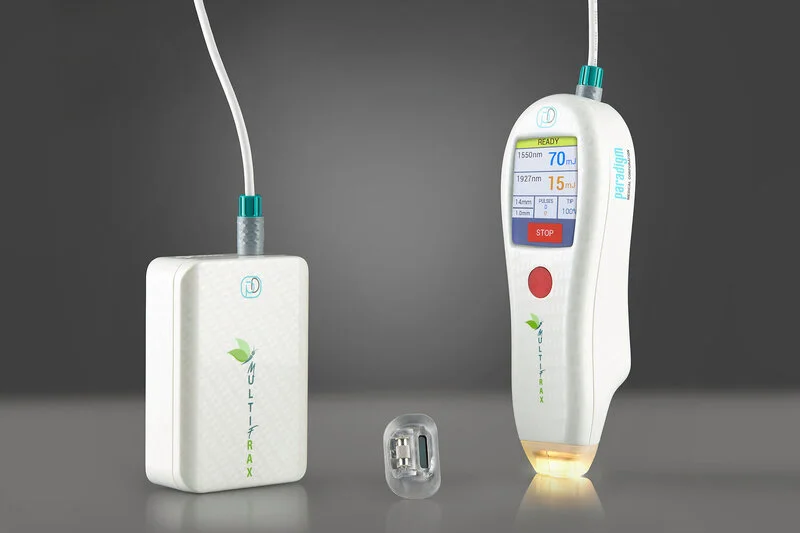
Multifrax is a non-ablative fractional laser developed by Dr Nikolai Tankovich, who pioneered fractional non-ablative lasers from the early 1990s. The current device was patented in 2020 and carries FDA 510(k) Class IIb clearance and a CE mark. It reaches the UK through distributors including AMP, which are distribution partners rather than the manufacturer.
What sets it apart is the optics. It carries two wavelengths, 1550 nm and 1927 nm, and its SimulScan tip can fire them individually or together in the same pass. The 1550 nm goes deeper to soften wrinkles, scars and texture, while 1927 nm stays superficial and works on sun damage and surface pigment.
Because it is non-ablative, it resurfaces without removing the surface layer of skin, so recovery is shorter than with an ablative laser. Both wavelengths work by fractional photothermolysis: microscopic columns of controlled heat are created while the skin between them stays intact, so healing is quicker than treating the whole surface.
At a glance
Device type
Non-ablative fractional laser (not radiofrequency, not ablative)
Manufacturer
MultiFrax, developed by Dr Nikolai Tankovich (MD, PhD)
Wavelengths
1550 nm and 1927 nm
Clearance
FDA 510(k) Class IIb (2020); CE marked
Signature tech
SimulScan, firing both wavelengths through one tip in a single pass
Best known for
Pigmentation and sun damage alongside texture and fine lines
Customisation
Scan width 2 to 14 mm; micro-column spacing 0.5 to 2 mm
Typical course
A short series, commonly 3 sessions a few weeks apart
Downtime
Usually 2 to 4 days of redness and light flaking
Skin types
Used across phototypes with settings tailored by skin tone
How it works
1550 nm (deeper): weakly absorbed by water, so its effect is mostly coagulative and reaches into the dermis — the wavelength for wrinkles, scarring and deeper texture.
1927 nm (superficial): strongly absorbed by water, so it concentrates in the epidermis where surface pigment and sun damage live, treating pigment with less risk of bulk heating.
SimulScan delivers both wavelengths through a single tip in one pass, so there is no need to swap handpieces or treat the same area twice.
Adjustable coverage: scan width 2 to 14 mm and column spacing 0.5 to 2 mm, so density and intensity match the concern and skin type.
The benefits
Pigment and texture in one treatment: dual wavelengths address surface pigment and deeper texture in the same session.
Less downtime than ablative resurfacing, because the skin surface stays intact.
A pigment-friendly wavelength: 1927 nm thulium light targets water, helpful for sun damage and uneven tone.
Customisable by skin type — coverage and energy can be dialled down for darker skin.
Versatile across the face and other sun-exposed areas.
Efficient single-pass treatment via SimulScan, rather than layering passes.
Concerns it treats
What to expect
Before
Consultation, skin assessment and, for some settings, numbing cream.
During
The handpiece scans the treatment area. People report heat and a prickly sensation. Sessions are usually quick.
Immediately after
Redness and a warm, sunburn-like feeling. Light flaking or a bronzed look can follow over the next few days, especially with the pigment wavelength.
Downtime
Commonly 2 to 4 days of redness and flaking.
Results
Tone and texture improve over the following weeks as the skin renews.
Course
A short series, often 3 sessions a few weeks apart, tailored to the concern.
What the evidence shows
The 1550 nm wavelength (deeper)
- Acne scars: a randomised split-face trial in East Asian skin found the 1550 nm erbium-glass fractional laser improved acne scars with far less crusting, redness and pain than an ablative CO2 fractional laser (Cho et al., JEADV, 2009).
- Safety in darker skin: across 181 treatments in Fitzpatrick III to V skin, complications occurred in only 3.3 percent, with post-inflammatory hyperpigmentation in 2.2 percent (Vaiyavatjamai and Wattanakrai, J Cosmet Dermatol, 2011).
- Stretch marks: the 1550 nm erbium-glass fractional laser treated striae distensae with high patient and surgeon satisfaction (Pacheco Guimaraes et al., Plast Reconstr Surg, 2013).
The 1927 nm wavelength (superficial)
- Pigmentation: two treatments with a 1927 nm non-ablative fractional laser produced moderate to marked improvement in facial photopigmentation, maintained at one and three months (PubMed 25607696).
The 1550/1927 dual combination
- A 2025 review of the dual 1550 nm erbium-glass and 1927 nm thulium system set out its mechanism, efficacy and safety, with protocols tailored by Fitzpatrick type (Friedman et al., Lasers Surg Med, 2025).
- In Fitzpatrick III patients, pairing the 1550/1927 system with pulsed dye laser improved burn-scar thickness, texture and colour where the risk of hyperpigmentation is higher (Tao et al., Scars Burn Heal, 2018).
Individual results vary and depend on assessment at consultation. Manufacturer figures are attributed as such.
Key facts
- Multifrax is a non-ablative fractional laser developed by Dr Nikolai Tankovich; AMP is a distributor, not the manufacturer.
- It uses two wavelengths, 1550 nm and 1927 nm, fired through one tip in a single pass via SimulScan.
- 1550 nm treats deeper texture and scars; 1927 nm treats surface pigment and sun damage.
- It is a laser, not radiofrequency, and non-ablative rather than ablative.
- Its 1550/1927 pairing is backed by peer-reviewed evidence for acne scars, stretch marks, pigmentation and scarring, including in skin of colour.
- Typical downtime is 2 to 4 days, with treatment usually given as a short series.
References & sources
- Friedman PM, et al. Current Trends and Future Directions of the Dual 1550-nm Erbium Glass Fiber and 1927-nm Thulium Fiber Non-Ablative Fractional Laser System. Lasers Surg Med. 2025;57(7):561-570.
- Cho SB, et al. Non-ablative 1550-nm erbium-glass and ablative 10,600-nm CO2 fractional lasers for acne scars. J Eur Acad Dermatol Venereol. 2009;24(8):921-925.
- Vaiyavatjamai P, Wattanakrai P. Side effects and complications of fractional 1550-nm erbium fiber laser among Asians. J Cosmet Dermatol. 2011;10(4):313-316.
- Tao J, et al. Treatment of burn scars in Fitzpatrick phototype III with pulsed dye and 1550/1927 nm non-ablative resurfacing. Scars, Burns & Healing. 2018;4.

Your skin has a story. Learn to read it.
UHai analyses your skin across multiple dimensions — tone, texture, pigmentation, hydration and more — and generates a personalised clinical report in minutes. No appointment needed.
- A clinical skin report, personalised to you
- Analyses tone, texture and pigmentation
- Free to use, no appointment needed
Explore FAQs on Multifrax Laser
Find answers to common questions about Multifrax Laser.
Non-ablative. It creates microscopic columns of heat without removing the surface of the skin, which keeps downtime shorter than an ablative laser. It is a laser, not radiofrequency.
The 1550 nm wavelength reaches deeper for wrinkles, scars and texture, while the 1927 nm thulium wavelength stays superficial for sun damage and surface pigment. SimulScan can deliver both in one pass.
Yes. The 1927 nm wavelength is particularly suited to surface pigment and photodamage, and published studies support its use for facial photopigmentation.
It can be used across skin types, and the water-targeting 1927 nm wavelength helps. Settings are kept conservative in Fitzpatrick IV to VI to limit the risk of post-inflammatory pigmentation, and a test response is advisable.
Usually 2 to 4 days of redness, with some light flaking or temporary bronzing depending on the settings.
Most plans involve a short series, often around three sessions a few weeks apart, adjusted to the concern and your skin.
Begin with a proper assessment.
Tell us a little about what you're looking for and we'll match you with the right consultation — at the clinic or virtually.